
Why Your Website Gets Traffic but No Leads: 7 Problems to Fix
More visitors can feel like progress. But if those visitors arrive, look around, and leave without contacting you, subscribing, booking, or buying, traffic may not be the real bottleneck.
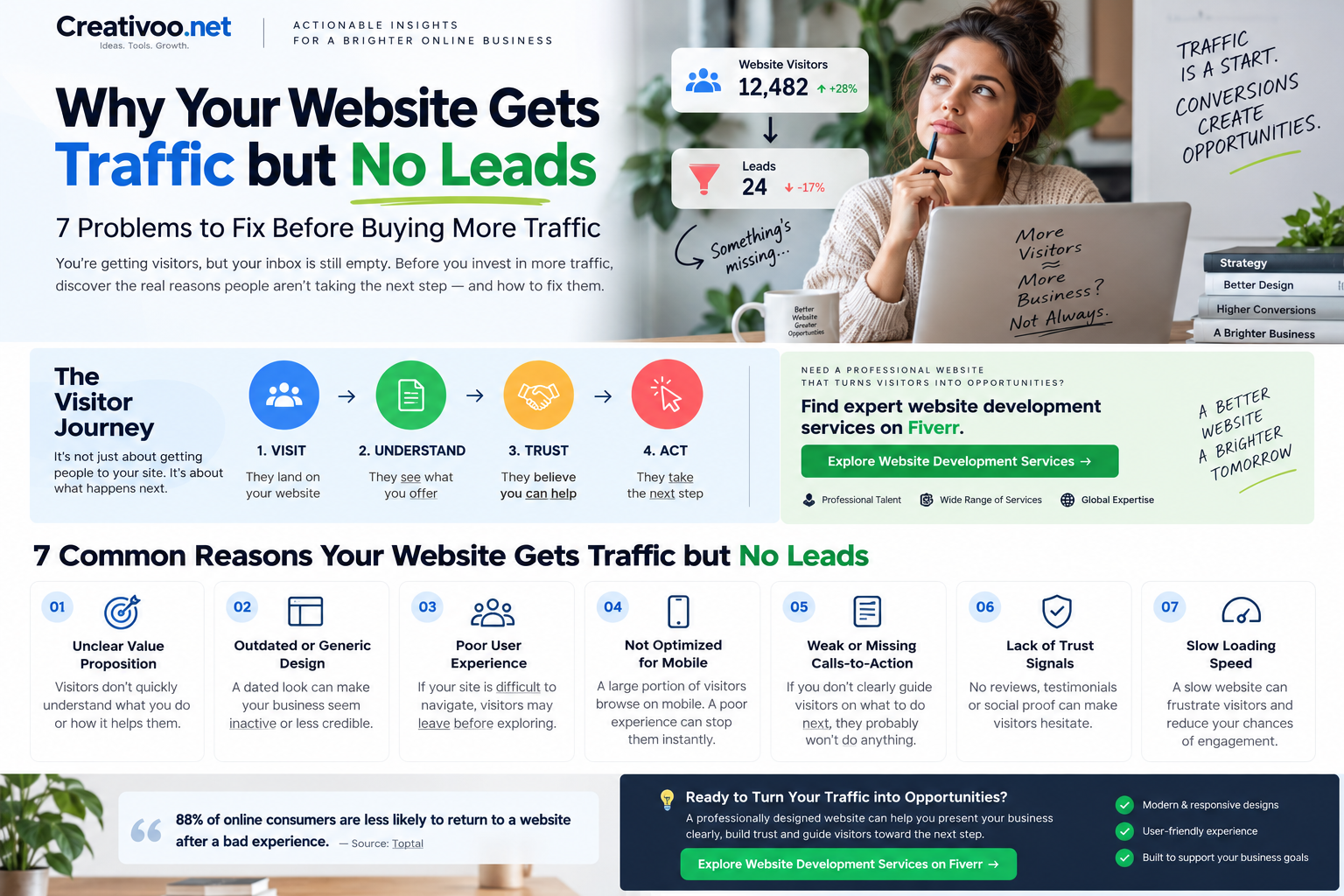
Traffic is only the beginning of the journey. A website can attract the right audience and still struggle to produce meaningful results if visitors cannot quickly understand what the business offers, why it matters, and what they should do next.
That distinction matters because buying more traffic before fixing conversion problems can simply send more people into an experience that is already losing potential customers.
Before asking “How do I get more traffic?”, it is often more useful to ask: “What happens to the traffic I already have?”
A lead usually has to cross four bridges
Conversion rarely depends on one button. Visitors normally need to move through several mental stages before taking action.
A weakness at any one of these stages can reduce the value of the traffic you worked hard to attract. That is why conversion problems should be diagnosed as a journey rather than treated as a single design issue.
Your value proposition is unclear
Visitors should not have to investigate your website to discover what you actually do. The first screen needs to communicate the offer quickly enough that the right person immediately understands why the page is relevant.
Clever headlines can look impressive, but clarity usually matters more. A visitor should be able to answer three basic questions within moments: What is this? Who is it for? Why should I care?
Your call to action asks for too much — or says too little
A call to action should reduce uncertainty, not create it. Generic labels such as “Submit” or a high-commitment request presented too early can make visitors hesitate.
The best next step depends on visitor intent. Someone researching a solution may be ready to explore options but not yet ready to make a major commitment. Your CTA should match that stage of the journey.
The page creates interest but not enough trust
Visitors can understand an offer perfectly and still decide not to act. They may be wondering whether the business is credible, whether the solution fits their situation, or whether taking the next step is worth the risk.
Useful proof can include relevant examples, testimonials, transparent explanations, portfolio work, credentials, realistic expectations, or evidence of expertise.
A strong strategy still needs a website that can execute it
If the underlying problem involves development, page structure, functionality, responsiveness, or implementation, professional website development expertise can help turn a conversion plan into a working experience.
Explore Website Development Support →The visitor journey contains too much friction
Every unnecessary field, confusing menu choice, broken element, unexpected step, or difficult mobile interaction adds friction.
Individually, these details can seem small. Together, they can make a visitor postpone an action that initially felt worthwhile.
Your website may be attracting the wrong traffic
Not every traffic increase is valuable. A page can receive more visits while attracting people whose search intent, needs, geography, budget, or expectations do not match the offer.
This is why raw sessions or pageviews should not be treated as the final measure of success. Traffic quality matters.
The page is visually polished but strategically weak
Good design is not simply decoration. It should create hierarchy, guide attention, improve comprehension and make the desired action easier to find.
A beautiful page can still underperform when visual elements compete for attention, important information is buried, or the layout does not support the visitor's decision-making process.
You are guessing instead of measuring
Without measurement, conversion optimisation quickly becomes a collection of opinions. Analytics cannot explain every human decision, but they can show where to investigate.
Look for patterns: important pages with high exits, forms that receive visits but few completions, weak mobile performance, CTA interactions, and traffic sources that generate attention without meaningful actions.
Diagnose before you buy more traffic
When a website receives visitors but generates few leads, avoid treating “more traffic” as the automatic solution. Start by identifying which stage of the journey is weakest.
Improve the offer, headline, message and page hierarchy.
Strengthen proof, transparency and credibility signals.
Review CTA placement, friction and the conversion path.
Revisit search intent, targeting and traffic quality.
More visibility works best when it attracts the right people
Once the conversion journey is clear, professional SEO expertise can help you work on visibility around the searches and audiences that matter to your goals.
Explore Professional SEO Services →Traffic is an opportunity. Conversion is what you do with it.
A website does not need to pressure every visitor into becoming a lead. It needs to make the right next step clear for the right person.
If traffic is already arriving, that gives you something valuable to work with. Study the journey. Find where attention turns into confusion, where interest turns into doubt, or where intent meets unnecessary friction.
Fixing those weaknesses can make existing traffic more useful — and puts the business in a stronger position before investing in additional acquisition.